Annual Reports That People Actually Read

Photo by Artem Podrez, Pexels.
It's Just Math...that We Make Pretty.
Oh, the annual report. It's the document that proves you weren't just sitting around in matching tracksuits for 12 months. It's often seen as a necessary evil, a bulky compliance document destined for a dusty shelf and skimmed by the one person who failed to unsubscribe from your mailing list.
"I love compliance," said no one ever, but here we are. You know what’s worse than writing the report? Having someone tell you they loved your last one, and you know they're lying. That's the stuff that keeps you up at night.
“I love compliance!” said no one ever...”
But here’s the actionable, non-joking part: For non-profits and small businesses, it is the single most important document for building trust, demonstrating impact, and securing future funding or investment. The secret to unlocking this potential isn't just in the numbers; it’s in the layout and composition. Think of it as a glow-up for your spreadsheets—you're taking your data to the makeover montage section of a 90s rom-com. Enhance!
Seriously, We Need the Money!
Why the Annual Report is Your Most Important Marketing Tool
as a Non-Profit
For non-profits, the report is a direct, public accountability document. Donors want to see clearly where their money went and the tangible results it produced. For example, The Association of Bow Valley Area Rockclimbers (TABVAR) uses its report to show that all funds go entirely towards hardware upgrades and new route development, having raised and distributed over $180,000 since its inception.
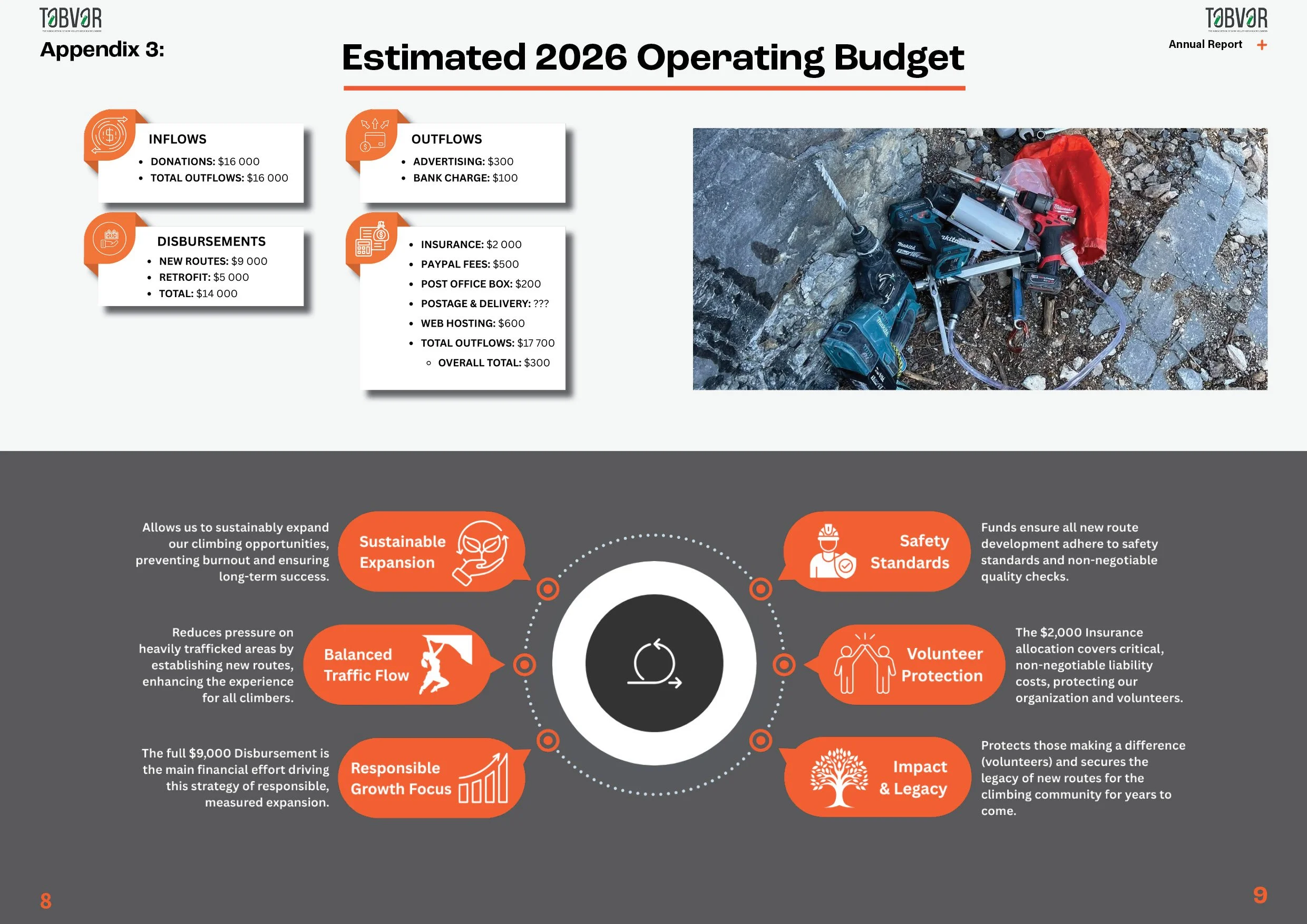
A professional layout visually reinforces this transparency—it proves you aren't just hoarding bolts and drills in a basement.
If you’re a non-profit, you have to prove you’re not shady. If you’re a for-profit, you get to prove you’re rich. It’s a beautiful system.
For small businesses, an annual report, even a condensed internal one, formalizes your trajectory. It tells a cohesive story to shareholders, potential partners, or even just your employees, grounding your brand's personality in quantifiable success. When presented well, it turns simple data into a compelling investment narrative. When presented poorly? Well, it turns your investors into tired people who secretly wish they were watching Step Brothers and wondering why they ever invested in you, you beautiful disaster!
“The process was seamless, and the final design perfectly captured our organization’s mission.
We highly recommend Patrick for professional and high-quality design work!”
The Anatomy of an Engaging Report
An effective annual report uses design not just to decorate, but to guide the reader through the data. This is where layout and composition are critical. It’s like being a movie director for your financial history.
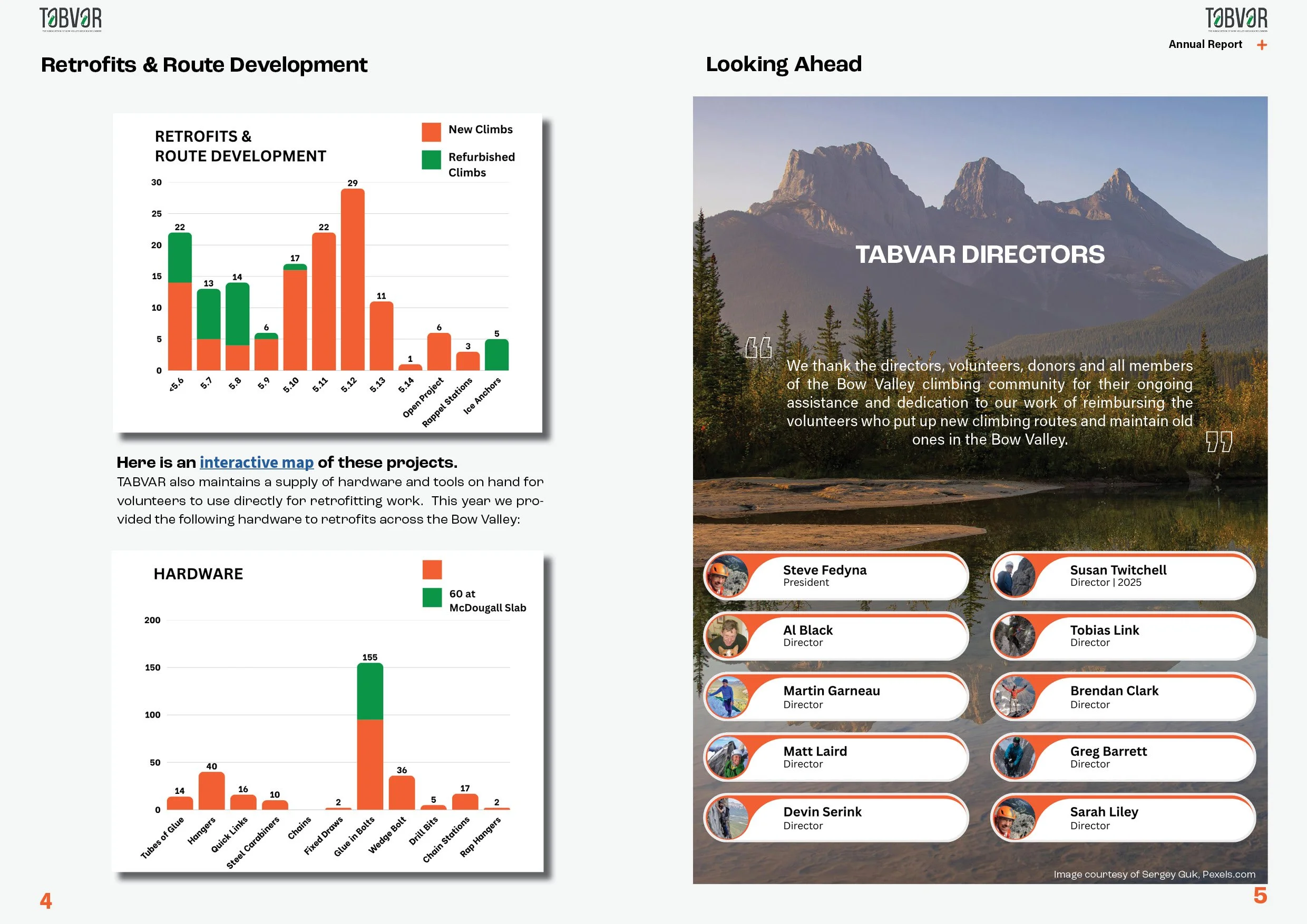
Annual Report design by Shifting Focus ©
“People don’t read. They scan. ”
Prioritize Visual Hierarchy and Scannability
Use Headings Strategically: Break the report into distinct, logical sections using clear headings (e.g., "Organizational News", "Financials", "Retrofits & Route Development". If your headings aren't clear, readers will assume the rest is chaos, and nobody has time to sort through that mess. That's the job of the government, not your donor base.
Leverage White Space: Don't cram the page until it looks like a tax document. Ample white space around text and visuals improves comprehension and makes the document feel less overwhelming. It gives the reader’s eyes a break. Think of it as the emotional buffer between one painful statistic and the next.
Show, Don't Just Tell: Use charts, graphs, and images to represent data. TABVAR, for instance, uses a stacked bar chart to instantly show the number of New Climbs versus Refurbished Climbs across different grades.
2. Embrace Data Visualization (Make those Numbers Pop!)
Raw spreadsheets kill engagement faster than a rainy weekend. Effective charts and graphs make complexity digestible. We're fighting data fatigue here, people!
Infographic design by Shifting Focus©
Use Infographics for Impact: Visually display key metrics like funding allocation or volunteer hours. If you want your stakeholders to feel your impact, show it in color. If it’s not colorful, it’s not real. (Just kidding, but seriously, use color.)
Tell a Story with Graphs: A bar chart illustrating hardware provided, like the one showing 155 Glue-in Bolts distributed, is far more powerful than a line item in an appendix. It shows you know exactly where those bolts went! You don't want people squinting at tiny font and muttering, "Is this a sign of success or a complete ethical failure?" Make it clear.
3. Add a Little Heart: Integrate Storytelling with Pull Quotes and Testimonials
A report should feel human. Pull quotes break up long blocks of text, add emotional weight, and summarize key concepts.
Image courtesy of Pexels.com
Strategic Placement: Place a high-impact quote next to a relevant section. Quotes like, "This just scratches the surface of all of the work done in the past year by folks willing to get behind a drill instead of going climbing!" 9 highlight the dedication of your volunteers (and their sense of duty over fun). You know, sometimes you just have to do the work, even when the fun thing is right there. It's called being an adult—gross!
Focus on Impact, not Activity: Use quotes that demonstrate the effect of your work, not just the task itself. If your quotes are as dry as a desert bone, you might as well have a graphic of a tumbleweed rolling across the page.
Don't DIY Your Dignity
Why You Need a Layout Specialist
Layout Design by Shifting Focus ©
“Typography is more than just picking a ‘nice-looking’ font—it’s a silent storyteller shaping how people perceive your brand.”
Many small organizations default to creating their reports in basic word processing programs, resulting in disjointed designs and poor readability. This is a critical mistake. If it looks like a hastily printed school report, it will be treated like one. If you want people to trust you with five thousand dollars10, you need to prove you can handle basic kerning.
A layout specialist understands:
Visual Flow: How a reader's eye moves across a two-page spread (it’s not random, we promise).
Information Design: Choosing the right chart type (pie, bar, or line) for the right data to ensure accuracy and clarity.
Brand Consistency: Using typography, color, and image treatment to maintain a professional, cohesive brand identity throughout the entire document.
Hiring a specialist ensures your report is not just submitted, but read. It transforms a tedious obligation into a highly effective tool for fundraising, community building, and sustained growth. Stop trying to make your word processor a graphic designer. You wouldn't hire an accountant to do open-heart surgery, would you? (Unless they're really, really detail-oriented and have the appropriate liability insurance.)
In summary, don't let a poorly designed report undermine a year of hard work. By focusing on a clear visual hierarchy, powerful data visualization, and compelling human stories, your annual report will become the valuable asset it was always meant to be.
Patrick Dunn | Shifting Focus Design & Photography